
|- axel.japan.report.live aus tokyo -|
- On Edos traces
- Roppongi Hills
- Tree culture
- The artifical island: Odaiba
- Hakone
- Wellington boots society
- Visitor in a "kokugikan"
- Ikebukuro
- The 47 samurai
- A last view
Visitor in a "kokugikan"
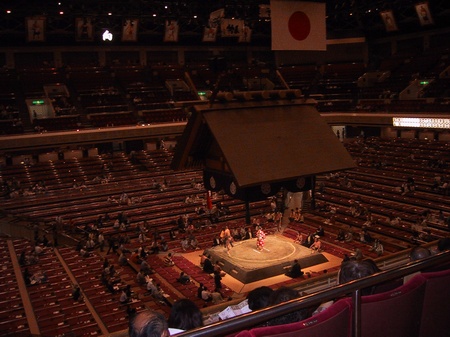
The sumo arena, where all bout take place, is called "Kokugikan". In Tokyo, there are three tournaments during a year, in January, May and Septembre. The three further tournaments take place in other cities in Japan (Osaka, Nagoya and Fukuoka). Each tournament lasts 15 days and sumo wrestlers have to do one bout each day of the tournament. The shimmei-roof is located directly above the "doyo" in the sumo arena and on places, which are very close to the "doyo", visitors are sometimes faced with a sumo wrestler who was thrown out of the ring.
Picture Source: Own exposure. Sumo arena: kokugikan.
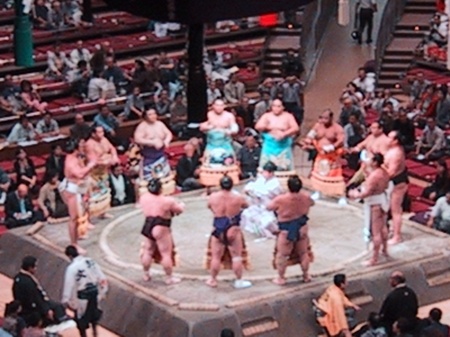
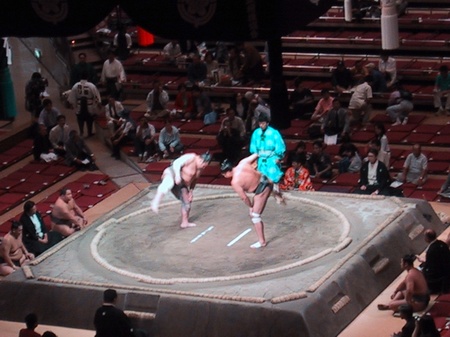
There are many traditional elements in the national sport, which is about 2000 years old. The presentation of the sumo wrestlers is one of these elements, you can see it on the first of the following pictures. Afterwards, each wrestling couple is called and the further rituals follow, such as stamping one's foot on the floor and clean oneself with salt. The higher a sumo wrestler is in the hierarchy, the longer these rituals take, because psychological aspects play a more important role.
Picture Sources: Own exposures. Rituals at a sumo tournament.
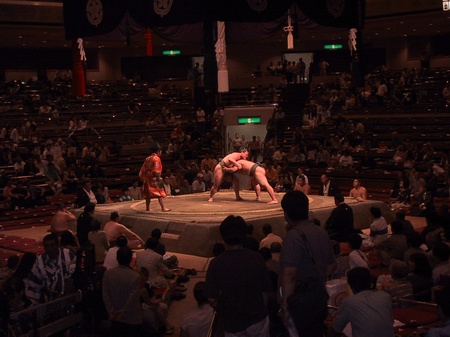
The bouts are mostly very short, but longer ones and those, which are more interesting in the viewpoint of strategy, are rewarded with multiple applause. There is one referee in the "doyo" and five other around it, with decide, which sumo wrestler has won. When decisions are very narrow, they come together in the "doyo" to discuss the decision. The rules are very easy: the one, who leaves the ring at first or who touches the floor with an other part of the body than the feet, has lost.
Picture Source: Own exposure. Sumo bout.